Two Attitudes: The Power of Poetry

There are two basic attitudes regarding the power of poetry.  The first is summed up by Tennyson’s Ulysses who, though old, manages to convince his men to sail with him once again “to strive, to seek, to find and not to yield.”  While the use of a persona puts some distance between Tennyson and these sentiments, this statement is exactly the sort of thing one might find etched on the foot of a monument.  Indeed, it is exactly that.  It is the phrase etched at the foot of the monument commemorating the death of the explorer who attempted to be the first to find the South Pole.  He was beat there, and on the return journey died, along with his crew, of hunger, exhaustion and cold.  However, this failure hasn’t stopped well-meaning writers, politicians, and explorers from citing the last lines of “Ulysses” as the spirit’s slogan.  What is more is that the gist of this attitude sounds remarkably similar to the sentiments of Milton’s Satan from Paradise Lost.  No politician who wanted to be re-elected would ever claim alliance with him.

The nature of Tennyson’s Ulysses’ sentiments suggests an emphasis on process.  In other words, it is one’s courage that counts, and not what that courage manages to accomplish.  The ends matter little.  There have been many times over the course of my career as a teacher, when I have read papers written by students citing these sentiments, or ones similar.  And very often, when one is facing difficulties or has suffered some loss, one is likely to receive greeting cards stamped with sentiments like this, too.  It is a particularly Western attitude toward adversity and one especially embraced by the can-do American.  Joseph Campbell called this the basic Greek attitude, embodied in a character like Prometheus.  Though at odds with the gods and punished for having disobeyed, his attitude was to endure the punishment – his liver was pecked at daily, only to regenerate so the torture could resume – and remain defiant, proud, self-reliant.  The contrary position Campbell points out is that of Job, who when meeting God’s displeasure covers his head with ashes.  Job’s attitude is one of humility before that which is greater than he is.  Prometheus’ attitude is that nothing whatsoever is greater than he is.

This brings me to the second attitude toward poetry’s power, which is best summed up by Dante’s treatment – some five hundred years earlier than Tennyson’s – of Ulysses.  Dante places Ulysses deep down in hell with the false councilors.  This Greek’s punishment for his presumption is to burn like a flaming tongue.  Ulysses recounts to Dante the manner of his death in a monologue strikingly similar to Tennyson’s.  The main difference is that Dante continues where Tennyson leaves off.  Just as Ulysses and his crew begin to approach the Mountain of Purgatory, which is literally the end of this world and the beginning of the next, God’s hand sinks the ship.  Ulysses and his crew are drowned and, when he wakes, he is in hell.  There are many reasons why Dante’s attitudes toward the Greek hero would differ from Tennyson’s, and there may be room to argue that Dante’s attitude toward Ulysses is more complicated than it seems.  However, what I think can be safely concluded is that Dante, whose narrative leaves Virgil behind once the pilgrim leaves the Mountain of Purgatory for the celestial realm, thinks poetry can only take one so far.  After that, the poet must rely on grace or a power greater than himself, greater than all human power, to reach what might be called Union with the Divine and, finally, the ultimate conclusion, which is the universe is moved by love.

I am often frustrated by the idea that poetry is an end in itself.  That poetry’s aim is poetry.  This tautology suggests, for instance, that experience’s aim is experience.  Talk to someone whose attitude about his life comes to this and you are talking to a boor.  His arguments come to little more than the sort of thing vacation photos and postcards come to, and that is, the following statement: I was there.  Perhaps this, in the end, is all the meaning, all the truth there is.  I doubt it.  But far too often, we conclude there is no larger meaning before we have tried to discover if this is so for ourselves.  The faithless accept this attitude, then, as an article of faith.  It is like one who concludes there is no God because the God of his childhood failed to provide him with an answer he needed.  Instead of searching for a God that would suffice, he quits and says, like the fool in the psalms, There is no God.

Whichever attitude one assumes regarding poetry’s power or the relationship of human will to divine will doesn’t matter much.  I read and admire poets of both sorts as long as they are genuine.   And I’m not going to make the Pascalian argument that believing is a safer bet.  There is nothing safe about poetry.  And that’s just it.  The argument I am prepared to make is this, then.  Whether one places one’s faith in the human spirit or in God, the basic character of faith is risk.  I can’t imagine a faithless poet worth reading.  And I can’t imagine a poetry worth reading that doesn’t risk everything.  Therefore, for the poet, there is no easy way out.
Posted in Starting from Poetry | Tagged , , , , , , | 1 Comment

Humility & Poetry

Eliot says that humility is endless.  And Thoreau says that “humility like darkness reveals the heavenly lights.”  But I’ve been thinking lately about a book called The Wisdom of the Desert, translated by Thomas Merton, which is a compendium of meditations, lessons and parables by and for monks.  The story I’m thinking about goes like this.  A monk is robbed by two thieves.  He asks a holy father what he should do, and that father responds that he should discover of which sin is he guilty.  This is a difficult attitude for us to understand and, even if we understand it, it is almost an impossible attitude for us to adopt.  My first understanding of this, which I’m not certain is entirely incorrect, was that clearly the monk, to have been robbed, hadn’t abided by his vow of poverty or charity and, had he, what was a felony would instead be an opportunity to do God’s will.  However, the more I think about the story, the more I think this isn’t a lesson in what the monk failed to do.  The father wasn’t chiding the monk.  Rather, this is a lesson about a virtue the monk might practice more perfectly.  That virtue is humility.

No one would get far, especially because we live in a world which can be so sad and violent, trying to convince the victim of a robbery that somehow he might attempt to be more humble so that next time he won’t get robbed.  Then again, righteous anger and prosecution have never protected a victim from being robbed a second time either.  The point isn’t, in the case above, that the monk won’t get robbed again if he just does this or this better or more perfectly.  That isn’t the holy father’s concern.  No one but God – at least, from the monk’s point of view – can keep anyone from anything.  And this is especially true for a monk, who relies entirely on God’s will.  So the holy father’s concern, rather, is the well being of the monk’s soul, which is most in danger here because he may be tempted to abandon humility to seek revenge, though that revenge might masquerade as justice.

The word humble comes from the Latin word for ground or earth.  The concept of humility, therefore, implies a “grounding,” or at least this is how I like to see it.  Someone who practices humility practices an attitude which brings him closer to the ground, closer to where his feet are.  This is why, when we pray, we kneel.  This is why on Maundy Thursday, the priest washes the feet of certain members of the congregation.  The idea being that he has come to serve.  The idea being that one imitates the divine not with solar crowns, but with a crown of thorns.  The point then isn’t suffering or sacrificing necessarily.  The point is finding joy in serving others.  And if you are to seek to amend anyone’s life, it might as well – and perhaps best be – yours.  After all, this is work enough and one might never see an end to it.  Should you try sincerely to amend your life and succeed perfectly, then perhaps you may begin to “remove the speck from your brother’s eye.”  Until then, remove the beam from yours.

I’ve said a lot here about humility, but nothing yet about poetry.  In other posts, I have called for a poetry which is as vital as life, but I should revise that now.  This suggests that poetry is the rival of life.  That poetry competes with life.  It can’t, and it shouldn’t.  That poetry must fail, because the idea there is that life ought to change.  Or that poetry ought to be as cruel or disappointing as life can sometimes be, as if life were a thing we ought to criticize.  I am no more interested in criticizing life than I am in criticizing the people who live it.  Not anymore.  The proper attitude of the poet, and the poem, might be the same as that of the monk – perhaps for different ends, but they need not be different – and that is this: to aid the understanding so that the poet might come to accept life as it is, and – at least for me – come to rely on the divine, whatever his conception of that is, more perfectly.  In other words, poetry ought to bring one to an attitude which, finally, says not But, but; or No, no; but Yes, yes.

This isn’t to say that a poet ought not exercise his judgment.  Nor should this suggest that a poet dismiss ideas regarding the imagination for those concerning inspiration or prophesy or something else.  A poet isn’t speaking in tongues.  Rather, it means that writing a poem requires all the faculties and gifts given a person.  Writing poetry requires more than mere courage.  It requires more than mere intellect.  It requires more than mere imagination.  It requires all if it is to see, eventually, a glimpse of its object.

Neither do I mean to say a poem can’t be as vital as life.  However, if a poet’s poetry is ever to be as vital as life, it must be as clear a channel as possible so that life shines through.  A true life shines through.  A poem must serve as a frame, and the poet himself a pane of glass.  A good poem might simply say: See?  It asks the question.  It doesn’t argue.  A good poem, then, is like the robbed monk.  It sits on a precipice looking out, and perhaps doesn’t know how perilously situated it is.  A good poem absorbs the blows and shakes of a storm, like a tree.  It offers up its limbs, its leaves, its life.  Its roots dig down to its source.  It drinks.  And when the storm passes, it listens to God’s voice in the gentlest breeze.

Posted in Starting from Poetry | Tagged , , , , , , , , , , , , , , | Leave a comment

On “Can Creative Writing Be Taught?”

This week in the New Yorker Louis Menand reviews a book called The Program Era by Marc McGurl.  According to Menand, the book attempts to make the argument – and I’m simplifying here – that the proliferation of creative writing programs has not only affected the way we write but the way we read, and that this is a good thing.  Menand concludes the article with a personal bit, where he reflects on his MFA days.  He says he hasn’t published or written a poem since graduation, but he wouldn’t trade the experience.  What Menand does best in the article is give a concise and clear history of creative writing programs in America, and worldwide, but, in the end, he does nothing to further the argument, one way or the other, or answer the question whether creative writing can be taught or not.  The best I can glean is that, he thinks, indeed, it can be taught because, well, look how many programs there are out there teaching it, and how many good books – more books than can be read – are being written.

Of course, the full impact of the MFA program, as it has been experienced in the later half of the twentieth century and the beginning of the twenty first, can’t yet be measured.  The books that have been written, the magazines that have been established, and the writers that have relied on its patronage have yet to stand the test of time.  I suspect there will be as many lasting writers outside the MFA circle as in, and that it won’t matter much whether a truly great writer had been exposed to a workshop or not.  The worst effect of the workshop might be temporary, and that is it has the tendency to encourage a sameness, which, if done well, can mask mediocre work and make it seem good.  Moreover, if one learns to read and make aesthetic judgments solely by attending workshops, then those judgments may be compromised by one’s erroneous expectations regarding what is beautiful.  There is something to be said for the statement I used to hear all the time in workshops, and that is: Kafka’s stories wouldn’t last a second here.  When we said that we meant to criticize the limitations of the workshop and not Kafka’s genius.

But before the eager writer or reader gets carried away regarding the evils of the workshop, one caveat must be mentioned.  It isn’t true either that just because you feel alienated from the workshop world that you are the next Kafka.  A friend of mine recently emailed me a correspondence he exchanged with a man, quoting Emerson, who believed that – again I’m simplifying, to make a point – because he was misunderstood, he must be great.  Sometimes the pith of genius is knowing the difference between divine madness and just plain, old ordinary shit house bonkers.  The safe bet, for me, is not to make that judgment about a self proclaimed genius lest I be judged, too, I guess.  It is best to judge the work on its own merits, should there be perceptible merits, and leave it at that.  Further, it is probably best to widen one’s aesthetic gauge to include all of what is beautiful.  This is the job of the writer and the reader of imaginative literature.  Again, the danger of the MFA mentality is that it can monkey with this gauge to the point of near uselessness.  But it is also true that a rejection of the workshop may lead to the same danger of dismissing what is good.

For me the question isn’t whether creative writing can be taught, but whether it should be taught.  I warn you that I’m biased.  I make my living teaching, among other things, creative writing at a community college in Suffolk County.  And yet, it has been my experience that teaching creative writing, especially to the non-creative writer – and for the most part, no one in the classes I teach has any intention, at least at first, of becoming a writer – is a benefit.  In fact, I would go so far to say that freshmen ought to be required to take a creative writing class before they ever step foot into a literature class.  Perhaps, before the program era, this wasn’t necessary.  Perhaps, when imaginative literature seemed in and of itself a good thing, this wasn’t necessary or warranted.  But now…  Well, now, it is.  A student who attempts to make a thing, and fails or seems to succeed, is better suited to criticize that which is far superior to his efforts.  It may be the poet, who fails and knows he has failed, that is best suited to begin to appreciate, for the first time, who and what greatness is.

I just want to say, before I close, that what I mention in the paragraph above has nothing whatsoever to do with encouraging greatness in literature.  Greatness can’t be encourage nor discouraged.  It is a thing, which is.  If it never becomes, it never was.  Whitman says that to have great poetry there must be great audiences, too.  This is true, from Whitman’s point of view.  But hadn’t he been great, really and truly great, what would a statement like this matter?  Perhaps the workshop creates the illusions that our audiences are greater than our poets.  This might explain some of the panic one occasionally hears surrounding the question of greatness and the weak arguments to counter such arguments.  These, the defenses and the criticisms, point to a tremendous lack of faith in the human spirit, which workshop or not endures, or rather, to be more specific, triumphs, despite and perhaps to spite our doubts.

There is one more thing, and this may have nothing to do, at all, with the argument so far.  But as I reread the post, it occurs to me that what is true for the poet may be doubly true for the seeker of the divine.  (I’m not sure these two ought to be separated, by the by.)  A lack of faith in greatness corresponds, in many cases, to one’s lack of faith in – or misunderstanding of – God.  For many, it is enough to accept defeat or victory, whatever it looks like or feels like, before one has sought thoroughly, before one has risked all or anything.  This not only points to a lack of faith but a lack of humility, which as Eliot says, is endless.  One must be as humble before the divine as one is before that which is great in us.  And if what is great in us is going to outpace us, then, perhaps it is true that it can’t be taught.  But neither can it be harmed, ultimately, by our feeble efforts to contain it.

Posted in Starting from Poetry | Tagged , , , , , , , , , , , , , | Leave a comment

In the Highest Limb, Satisfied

My thoughts these days have revolved around prayer rather than poetry.  For me these two aren’t so far apart.  Many of the poems I have written are more prayer than poem, as far as I’m concerned anyway, especially if the aim of a prayer is to say, at last, Thy will be done.  (Essentially, this is what it means to say, Yes.)  But I think it is more than that.  As I have mentioned in another post, what strikes me about prayers, like the psalms, say, is the stance the psalmist takes toward the divine.  In the case of the psalms, the stance can shift from verse to verse, and sometimes from line to line.  A good prayer, a good poem – at whatever divine object it is aimed – will, must do the same.  It is the mapping of these shifting attitudes, which reveals, at last, who we are, what our trouble is exactly, and from where we have come and are going still.

Therapy works this way, too, and so does confession.  Sponsorship, for those in 12 step programs, works this way.  And the best confessors, therapist and sponsors offer us a chance to see the patterns which emerge in our lives and in our prayers.  The primary difference between prayer or poetry and these three activities is that what was aimed before at God is now aimed toward another person and what may be divine in him.  And yet poetry, even when published in a book, hardly asks its reader to be responsible for the mapping of the poet’s life or pointing to possible patterns there.  A poem doesn’t ask for forgiveness or strength or guidance.  It asks for a reader’s attention.  It asks for the reader to assume, as if entering into a church, an attitude of reverence.  It is this attitude, if done correctly, lovingly, playfully, which opens up in us the possibility to see not the poet more clearly but ourselves.

I guess all relationships offer us the possibility of seeing ourselves more clearly.  And it is in service to others – at least, this is what I am coming to understand – that we see what is best in us, what is most divine.  It isn’t enough, then, merely to write poetry or, for the religious, to pray.  One must also do something, because if we are to see the divine every day we must see it in other people.  We must find it living in our community, in our homes, and in our lives.  And it is there.  One can find a record of it even in the darkest poems and the most contentious prayers.  The aim, then, if one is to read a poem, would be to align oneself with the divine.  The aim of reading a poem is to say, Yes.

And haven’t we all had that experience?  The last line of the poem leaps or dribbles or rises from a poet’s lips, and we sigh and say, Yes.  It is the sigh itself, which anticipates the affirmation.  It is the spirit’s response, which I say the intellect hears and must answer.  It is easy, however, to hear this sigh and affirm it, but it is far more difficult to keep that yes on one’s lips all day or through the night.  It is this that makes poetry or prayer essential.  We must struggle to find that which we ought to do.  Or, better still, to find the strength to continue, when we have grown weary or confused.  And yet how many poems celebrate, too, and say only, “Yes, this is a beautiful world, and I am grateful”?

It is a beautiful world, however horrifying it seems.  I might have said “from time to time” here, but that wouldn’t do justice to the horror.  There is always an element of the horrible.  The stooping of the hawk, for instance, which arrests me every time I see it, means the snake will soon be seized.  And yet what a sight it is to see these two, as if one, rise from the field.  I can imagine even the snake must say, Yes.  After all, what good would his No do him?  Even his struggling seems more affirmation than denial, to me, as if he were saying, Yes, take me up but I will make the ascension difficult.  I will make it cost you dearly.  The hawk’s Yes perches, finally, in the highest limb, satisfied.  The best we can do is take note, and say: It is true.

Posted in Starting from Poetry | Tagged , , , , , , , , , , , , | Leave a comment

On Poetic Insight

I listened to a good friend and a fine poet lecture on teaching writing a few weeks ago.  I was impressed especially by how she goes about teaching.  Her pedagogy is very similar to mine, and I chalk that up to the fact that we are both poets, who happen to teach.  But it isn’t about where we are similar that I would like to speak.  It is about where we differ.

The poet friend I mention above concludes, somewhere in the middle of her lecture, that one can’t teach insight.  In other words, when teaching writing, one can’t teach a student writer to have an insight.  Of course, this may be true.  But one might lead one to an insight.  One might point out this or that, and have the student suddenly see, what is indeed there to be seen.  That is, only if it is there to be seen and the student be willing to see it.  I come to this conclusion because of my own experiences with writing, and in particular writing poetry, which I believe provides the most opportunity for insight.

In my last post, which was written during a few especially dark weeks for me, I posit that my recent experiences with a poetic sequence has led me to the conclusion that self-knowledge, even for the most earnest seekers – and for good or ill, I count myself as one – is difficult at best and might be impossible.  I would like to revise this understanding now.  The problem for me wasn’t that the poems weren’t speaking.  In fact, they were.  And if they repeated themselves it was because I refused to listen.  The insight, whatever insight there was to have, is there to be had.  It shines now, for me, because I have eyes to see it.  When I consider, too, how gentle that voice is, how patient, too, I feel somewhat ashamed.

I have been fond of saying that every moment is an opportunity for grace.  An opportunity to wake up.  And I believe this to be true.  It oughtn’t be remarkable that a man suddenly realizes this or that about himself, or God, or the world.  It is remarkable that he doesn’t.  That he isn’t always running about with his hair aslant and his eyes wild.  This is why, for me, the idea of teaching insight seems the most reasonable of pedagogies.  What else is there for a good teacher to do, but say: Isn’t this something?  A poem is both a record of an insight, and an opportunity for insight.  A man might learn as much about himself by reading another poet’s work as he would be reading his own.  And a teacher might reveal for his students what is there to be seen in their work and elsewhere, if he dares.

It is understandable to grow impatient with the process that leads to poetic insight.  I suspect to be done truly and well one may have to wait the length of one’s life to get it all. I think it was Rilke who claimed that, perhaps, it comes at the end, some word returns, which you have been speaking from the time of your conception until now.  I know what mine is.  And I will say it here, though soon I will forget it again, and have to be reminded over and over.  The word is the same word the wind announces, when it throws the trees about, and the word the trees repeat back to the wind.  The birds in my yard have it on their tongues.  I listen, and hear.  It is: Yes.

I had been saying, No.  And as long as that was my word, I might only catch glimmers and snatches of the truth.  Perhaps, it is because I waited so long to see that everything today seems so bright.  My heart is unburdened and, though still a little cracked, shot through with light.  It may be truest of long poems to say that their greatest effect is the lengths a poet is willing to go to resist what is inevitable.  And perhaps the longest, most fulfilling lives come to the same conclusion.  I hope so.  But even if I’m wrong, this is a chance I’m willing to take for one poetic insight.  So what if it comes again and again and again.

Posted in Starting from Poetry | Tagged , , , , , , , , , | Leave a comment

A Few Thoughts After a Long Trip

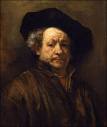
RembrandtIt is part of the poet’s job to get used to his inner rhythms, those seemingly predictable patterns which, from a distance, map his temperament.  I was reading some old poems yesterday and found that, as I have always hoped, the new poems I have been writing and the ones I wrote several years ago not only address, as if part of a single poem, the same subjects and attitudes, but also, in some cases, I found that I use the same or similar language to do so.  One of the frustrating aspects of all this is that what may feel like a revelation, some new vista, say, stumbled upon while out walking, may only be the same old field, the same old tree.  I ask myself: Have you merely forgotten?  This experience casts into doubt one of the possible uses of poetry, which is to come to an understanding of self.
I remember a long time ago, reading Augustine.  Somewhere in his Confessions, he exclaims: Who do I know better than myself!  And I thought then – as I seem to be thinking now – that we never know ourselves so well.  And if there is anyone who tried to know himself, it was Augustine.  I think what he says, from a certain point of view, is true.  We might know ourselves better than we know others, and that includes the animate and the inanimate, the solid and the ethereal world, but we know ourselves but slightly.  Even the best and most perceptive of human beings catches himself only in snatches and glimpses.  It is as if, rising from sleep, some terrifying and beautiful dream, thirsty, half-blind and exhausted, we passed a shadow in the hallway and thought, touching its cheek: Who?

And it isn’t that we contain multitudes that makes knowing ourselves so difficult either.  We might contain many points of view and many possibilities – I doubt it most days – but what is so frustrating, and the more I write the more frustrating it becomes (though some days it amuses me), is that even the most familiar gestures and sentences and dreams startle us again and again and again.  I don’t remember where I read this, but someone said that, when we are young we hear a knock on the door, and think: Yes!  And then, later, when we are old and tired, dozing in a chair, we hear a knock on the door, and think: Yes…

A poet returns to the same images over the course of his career, and when he is young these reoccurring images seem some hint, some indication that his work might come to something.  These, he thinks, are the vestiges of the angels.  God’s footprints left for me to follow.  Then, he rounds the corner again.  The sun shines on the leaves, the spring flowers before his eyes, the animals emerge from their underground lairs.  The world is refreshed, but he is weary.  His hair has fallen out.  His clothes are ill-fitting.  He has seen this all before.  These revelations aren’t what he thought they were.  These footprints are his, the ones he left – when was it? – last spring, walking this way.

Wisdom is, perhaps, the beginning of an understanding that the essential truths are always just beyond us.  And that what seems to be a revelation may be merely a familiar thing we have forgotten.  It is as if we return to childhood often, some perfect day, the sun high in the trees and the birds singing, and it is to this day that we return finally.  However carefully we have chronicled these hints, these images, they come always as a mystery.  And it is of this surprise we tire.  When I look at a Rembrandt self-portrait, this is what I see.  He stares back at us, as if to say: Would you really exchange places with me, if you could?

Posted in Starting from Poetry | Tagged , , , , , , , , | 3 Comments

The Dead Don’t Sing

I was feeling pretty awful the other day.  It was the 17th.  I know that because I picked up my Book of Common Prayer, turned to the psalm reading in the psalter for the 17th day, and read psalm 88.  This felt serendipitous.  Augustine, when he finally surrendered, heard a raggedy boy in the distance repeating, “Take it up, read it.”  Augustine leapt for his Book of Books, opened at random and found the words he needed to find exactly.  The rest is history.  And Merton, I remember reading, desired desperately at one point – this is somewhere in the Seven Storey Mountain – a similar experience, but I don’t think it ever came to him.  I’ve played before, during moments of crisis, with this, opening books to find a relevant and illuminating passage.  Perhaps all readers, who read for help and hope, do this.  The Latin word for reading means “to pick out,” and is related to our word “election” and “selection.”  The idea being, I guess, in Augustine’s case and in Merton’s,too, that something divine selects the passages for us to communicate an eternal truth made now particular for our circumstances.  It is perhaps easier to think this with holy books.

What interested me about psalm 88 is what always interests me when I read the psalms.  And that is the psalmist’s stance.  Anyone who reads the psalms closely can’t miss that the singer of these songs struggles and argues and attempts to persuade his God as much as he tries to appease and praise him.  In 88, he comes to this:

I have stretched out my hands to you.
Do you work wonders for the dead?
will those who have died stand up and give you thanks?
Will your loving-kindness be declared in the grave?
your faithfulness in the land of destruction?
Will your wonders be known in the dark?
or your righteousness in the country where all is forgotten?

There is an irony in these lines, which strikes me.  One reading, given the lines which lead up to these and the ones that follow, suggests that the psalmist wonders whether he is alive or dead.  God has forsaken him, hidden his face, and placed the psalmist far from his friends and supporters.  In this way he is like the dead, who can’t complain or praise.  And this is the point of a second reading.  The psalmist here also seems to be suggesting, because he sings God’s praises, that he can’t be dead.  God doesn’t work miracles for the dead because the dead can’t fulfill their end of the bargain.  The dead don’t sing.

Harold Bloom, in his book on Wallace Stevens, talks about three poetic stances, Pathos, Logos and Ethos.  He claims that every poet moves between these stances, though each may name the experience differently.  Emerson, for instance, called these Power, Freedom and Fate.  To put it simply, a poet seeks for meaning (logos), experiences moments of success (pathos), but ultimately must resign himself to failure (ethos).  The last failure, of course, is the failure of the flesh.  I feel a great anxiety when I read the last lines quoted above and consider this.  The palmist seems to be teetering on the edge of something dangerous.  Ought one worry about “righteousness,” when one is going to “the country where all is forgotten”?

The last words of Whitman’s poem So Long are these: “I am as one disembodied, triumphant, dead.”  I remember listening to a lecture on Whitman, where the lecturer concluded that the last word was ironic.  Whitman wanted each edition of Leaves of Grass, following the composition of this poem, to conclude with So Long.  He wanted the last word of his book of books to end on this note: dead.  The irony isn’t, as the lecturer I heard suggested, that Whitman isn’t dead.  He is.  But that he considers this death, his particular one, a triumph.  One must feel an overwhelming tenderness for Old Walt at the end of the poem.  If he does stop somewhere, waiting for us, it is at the conclusion that, as Hamlet says: the rest is silence.

Success for the poet is different from the success of the saint.  The saint wants to be one with the divine, but the poet – and I would say the psalmist is more poet than saint – wants to be alive.  He wants freedom from fate, from death.  The saint wants to be alive, but his “alive” and the poet’s differ as stars from shine.  The saint’s freedom lies in a death of self, while the poet’s freedom lies in a fulfillment of self, even an exhaustion of self.  When the poet surrenders he does because he hasn’t a choice.  The saint gives freely what the poet gives begrudgingly.  The triumph at the end of Leaves of Grass, then, and in Hamlet’s end, is that both seem to be surrendering what was never theirs to surrender.  Their spirits are as unsponsored as anyone’s spirit can be.  It is for this reason we can hardly approach them, however we try.

The psalmist’s triumph is incomplete from this point of view.  He concludes his psalm in darkness, still reaching for his God.  But where he does succeed as poet is where he questions, and almost concludes: that God needs him as much as he needs God.

Posted in Starting from Poetry | Tagged , , , , , , , , , , , | Leave a comment

Ours to Love

I literally wrote myself sick last week.  Mostly I think this was because I stayed awake for twenty-four hours the day of the big snowstorm to finish a series of poems, which I began perhaps a week before that.  I don’t know what else the poems may have discovered – perhaps nothing much – but I know I realized something: I can’t stay awake for twenty-four hours anymore.  I didn’t feel right for days.  Finally, I’m more myself.  And I’m thinking of starting a new project, though I’m not sure what or how or if.

I did come to something else after writing like that.  The gist of which goes like this, and stems from the question why should one write poetry?  If the purpose of art is to find and love the universal in the particular, then wouldn’t it be better to pass on this activity and love the particular in the universal, which may be – actually, I’m not really so tentative on this point – the aim of all living?  I guess this boils down to an understanding that being a good, great or even decent poet doesn’t guarantee one will be even a marginal human being.  This has always been my great hope.  That through poetry someone might, if not become a good man or woman, then at least he might become a better one than he otherwise would have been.  But perhaps this is still the case.

Here is what I mean.  If one finds the universal in the particular, and loves it, one experiences what Freud called the oceanic effect.  One may be transported into that richer atmosphere, where all is one.  Here we exist as pure principle, where merely to will something is to accomplish it.  I know that this sounds like a bit of mumbo-jumbo, and it is, but I don’t think that this should mean we ought to completely dismiss the experience this formula suggests.  It happens.  It is.  And yet it isn’t, too, because while the effort it takes to achieve such an insight produces the desired effect, the effort can’t be sustained very long.  One must return to earth, to its obligations, its push and pull.  Here, on the flat ground, one’s will is thwarted, and the supreme virtue is humility.

And this may be the point.  This is how the change occurs.  Having been lifted into that realm, where to will is to do, and now having returned to this ordinary earth, one must don new duds.  The old clothes of peacock don’t suit, and the celestial robes of the ether don’t either, but one asks now for a rough tunic.  Now one crawls along the ground, loving particular stones and particular grains of sand because having seen the large one comes to value the small.  Even the stars might come to this conclusion, and cease pitying us.  They may be, indeed, the gods we hope they are, who love us because we are more fragile than they.  Or as fragile as they, who aren’t really abundant, but as unlikely and uncertain as we.

This world, all of creation, wants our love.  It asks fiercely for it.  And still remains aloof.  It is our one gift to motion toward.  It is our one human virtue, and it is rare – it must be – to love this weakness in ourselves and in all things.  Better, it is our triumph to see it isn’t weakness at all.  It is our crown.  It is our strength.  We love, as if it were forever, that which may not even be.  The light of stars, to which we pray and on which we wish, is gone before we open our eyes.  And yet that oughtn’t change a thing.  And, it seems, as if it doesn’t.  Still, we lift our voices to sing or cry to that which can’t or won’t hear or understand.  Love, the kind I mean, requires the knowledge that all love is wasted.  And yet seems more precious because it is.  It is.  And we are, however small and insignificant, fierce in love with that which is ours to love and can’t last long.

Posted in Starting from Poetry | Tagged , , , , , | Leave a comment

On Greatness

There seems to be an anxiety felt by the Baby Boomer generation that the world, when they have gone, will cease to be.  It must be a consequence of their belief that the world, before they entered it, didn’t exist.  Or, if it did, existed in some corrupt and unhappy form, which thankfully they righted and redeemed.  Largely, they achieved this monumental task by virtue of their insights and their actions, all which occurred between the years of 1965-1969.  In 1970, Adam and Eve were cast out of paradise and disco was invented.  Drugs became dangerous, and anonymous sex with many strangers deadly.  It was for these reasons that the Baby Boomers took jobs they didn’t want, stopped smoking pot, moved to the suburbs and toyed with the idea of becoming Scientologists.

Of course, I’m kidding.  Sort of.

Obviously, the passage above comes from a long-held resentment of having to live in the shadow of a generation, whose values seem to have created the culture in which I live.  Their agendas, for good and for ill, have dominated the world stage for the last forty plus years.  They have chosen not only the debates but the language of those debates.  And still, just when their influence ought to be retreating, they seem to want a re-dawning.  Their insistence, for instance, that sixty is the new forty, or whatever the fuzzy math concludes, suggests a great deal about them, which isn’t flattering.  The first and most damaging is they they never want to grow up.  This Peter Panism isn’t even denied usually.  Rather, it is embraced.  After all, who wants to grow crotchety?

But what they call crotchety might also be considered wisdom.  And the beginning of wisdom, as Solomon says, is fear of the lord.  I have an Emersonian take on this, I think, and think of his Lords of Life.  Those principles upon which we rely, whether we like it or not, and which in the end must triumph.  In some ways, the BB’s are as much an embodiment of Emersonian principles as any other before or since.  The worship of “now,” which is the only eternity any of us will ever know, has been so deeply accepted that it hardly seems worth my while to illustrate the ways in which our culture values the moment.  But this cult-like worship of now has led to a kind of apocalyptic resignation.  A good friend and teacher once described the two guiding poems of his generation as Arnold’s Dover Beach, on the one hand, and Yeats’ The Second Coming, on the other.  The resulting life’s philosophy resembles a logic which goes something like this: a terrible beauty is slouching toward Bethlehem to be born, so let’s do it, baby.

I am generalizing and this means many – I suspect anyone born between the years 1945 and 1960 – will find fault with what I’m saying.  I’m certain many educated by the BB’s will also find fault because generalizing is a taboo.  We don’t speak in generalizations.  Rather, we have been taught to speak in moving anecdotes followed by impressive statistics.  The truth seems then beside the point.  I guess my argument would be this: one might get as close to the truth by generalizing as one might by the formula cited above.  The advantage of generalization is an expedience, which mimics clarity more closely than anecdote or statistics.  And it is clarity I am after.

Recently, I read an essay in the NY Times on greatness.  David Orr examines the idea of greatness in poetry, especially contemporary American poetry, and suggests that “American poetry may be about to run out of greatness.”  The reason I say suggests instead of states is that I sense a kind of irony in his tone, and I hope that, considering the rest of his essay, he both means this and doesn’t.  Or that he senses that this is the fear of poets in the poetry world and yet hopes it isn’t true.  Perhaps, he is even suggesting that one must redefine greatness in poetry, or that the job of the great poet is to redefine it for us.  As, inevitably, great poets do.  In fact, it seems to me that this is the indisputable effect of greatness.  Before there was that and now there is this.

When one thinks of great poets certain names rise to the surface.  Mostly, these names don’t differ that much from poet to poet (or even from non-poet to non-poet).  Where they do differ, there is room for debate.  But where there is overlap, there is none.  I don’t mean greatness is consensus.  What I mean is that greatness removes the opportunity for debate about greatness.  I suspect that the twentieth century will produce, perhaps, a single great poet.  Perhaps it will allow room for two.  The two great poets of the nineteenth century are clear to us: Dickinson and Whitman.  One might debate which is greater, but not that one is and one isn’t great.  The twentieth century is a little harder to be definitive about, but for me two names emerge: Stevens and Ammons.

For us, the mountain any poet must climb is Stevens.  One might begin judging Ammons by substituting in all of his mountain poems, of which there are many, Stevens’ name.  Whether Ammons traversed that rocky terrain or died along the way remains to be seen.  His footprints, however, are there.  They are clear imprints in the snow.  And how we might know his fate is by taking the pass ourselves or finding our own way.  Either we’ll find Ammons’ bones littering the face or, cresting the peak, find another mountain beyond gleaming with snow.  Greatness means climbing the mountain and becoming a mountain.  Then our shadows might stretch all the way to the sea.

One of the less charming traits implied by my perhaps unfair assessment of the BB’s is that they can’t conceive a greatness beyond their own.  The risks they have taken are all the risks there are.  And, however well they have prepared the next generation, our generation, we might never do as much as they.  They underestimate, and encourage us to doubt, our ripeness.  It is we who are now in full flower, and not they.  If the world dims now, it dims for them.  For us, it is all shine.  It is noon.  There is no better time to set out.  There is no better time to risk than when one’s sight is as large as the sun’s.  Let them enjoy their illusions in crepuscularity, while we dawn for ourselves.

To be great is to be misunderstood, Emerson says.  If there is to be great poetry for us we must exercise virtues and principles, which have been considered dubious by our teachers.  Once their assessments mattered, but now, in this eternity which is ours, they don’t.  There is a reason Obama’s rhetoric of hope resounds for so many.  He aims for greatness.  He desires to be the poem that took the place of a mountain.  It is for this reason his challengers, Baby Boomer’s all, underestimated him.  It was this underestimation, which we might substitute for Emerson’s “misunderstood.”  Still, his greatness isn’t assured.  But it is more assured today than it was yesterday.  And tomorrow, when he wakes to open his curtain and recognizes his image lighting the grass and all the empty trees, he will have come another step closer.  Until we can posses, as poets, a spirit like this, we will start at shadows and cast none of our own.

Great poetry, as I have suggested in other posts, must be a poetry which matches the vitality, the attractiveness and the relentlessness of life.  The great poets of the twenty-first century will find exactly the right words to match this world, this now.  And it will seem, after all the dust settles, that the words they found were the right ones, the eternal ones.  Perhaps, the great poet will come from the established poetry world, and perhaps she is writing her poems in secret to an audience of one.  It doesn’t matter.  Greatness isn’t necessarily what one aims to do, it is what one does, even as life isn’t what you hope it would be but what it is.  A great poetry reconciles us to the fact and becomes a fact itself.  The way is fraught with uncertainty and danger.  The qualities necessary to meet the challenge have been etched in stone for anyone to read but only the few, the elect to live.

Posted in Starting from Poetry | Tagged , , , , , , | 6 Comments

Noli Me Tangere

Noli me tangere

Noli me tangere

Our conceptions of God and God are not the same thing. This is why, for me, poetry surpasses religion in the knowing of God, because poetry looks to discard the concepts that don’t work to discover and embrace the ones that do. This takes forever, and is a constant sloughing. However, for loving God, which is different from knowing, religion is better. That’s all the religious do: love God. Whatever and whoever he or she is. A man might participate in a religious life and a poetic life. I see no contradiction here. One can love the thing he doesn’t know as he gets to know it. (Isn’t this what marriage requires of us?) Finally, the object of the mystic is to become one with God. That union is a forgetting beyond all knowing and loving. It is big and it is fatal.

I’m speaking simply and generally here, and that means I am misleading you. Inevitably, this must be the case, because it is impossible to talk about these things, love and God, directly. The words are tropes for experiences, which are larger than all words. The word “wind,” for instance, doesn’t do the wind any justice. All words fall short. All poetry, all good poetry, ought to point that out. A fair reading of every poem might be: If I could say what I mean these wouldn’t be the words I would use. And yet, aren’t these better than the words I used yesterday, when last I tried to say it? If you work your relationship with your lovers and friends and neighbors that way, you will be wise. If you work your relationship with God that way, whoever you think he might be, you will be happy.

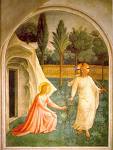
There is a subject of medieval painting, depicting a scene from the book of John which is particularly instructive.  Mary Magdalene sees Jesus after his crucifixion. First, she mistakes him for a gardener. And when she realizes he is, indeed, he – the same thing happens with the two nameless disciples on the road to Emmaus – she falls to her knees and attempts to touch the hem of his robe. Christ says, “Noli me tangere.” This has been translated to mean: Let no one touch me. But this is a mistranslation. The original Greek, from which the Latin comes, means something like: Don’t let anyone hold on to me.

I grew up in a house where the word God was never mentioned. My father was a lapsed Catholic, and my mother an irreligious Jew. Whatever God I have found, or whatever piece or glimmer of God, or whatever experience of God I have had, has come from seeking, from partial revelation, or from chance. I have had no concept projected before me to accept or reject. Therefore, this message “don’t let anyone hold on to me,” is easier for me to practice. The resurrected Jesus means: this image, this flesh that you see, isn’t what I am. I am something else. That which “flees,” as Dickinson says of poetry. When the book of Thomas – a Gnostic text – has Jesus saying, “Turn over a stone, and I will be there,” this is what it means. Or, to put it in Whitman’s terms: I stop somewhere waiting for you. Or as Yahweh says: I am that I am. These lines are ironic. They don’t quite mean what they say, and serve to undermine all expectations and even language itself, which is always a little ironic and confusing. Jesus’ directive to Mary, who was his special consort – or spouse – means let go of what you think I am, and then you will experience me. 

Jesus as the way, or The Way, for the religious person, for a Catholic, means one thing. But to a free, unsponsored spirit, that is, for the poet, he means something else. He is a pattern. A way. But so then are Whitman, and Dickinson. And Stevens, when he says, “We say that God and the imagination are one…” This revelation is stunning, when you think about it. A misreading, and a weak one, would be that both of these things, the imagination and God, aren’t true: God is an illusion. A better reading would be both are the only truth. God is a fiction, but so is the all of everything, a wonderful, beautiful, true fiction. What we see and think are the only things that are. The rest is poverty and dust. One must align oneself ultimately with consciousness, which is that which illuminates the world. Consciousness, like the sun, is a light wherever it goes. Love, then, for me, is the experience of this light rising to meet its image in another. The little flame of my love leaps when it sees the sun set, the image of a man at his love’s window, a mother holding her child and touching him gently, a father strong and tall.

I find these images everywhere. In the wind, in the sun, in the music of the trees. And I see them, too, in the relationships of one person to another, a solitary walker against the glimmering far away, or a shadow moving over a distant landscape. We move closer, if we can, and learn to love the motion toward. Each step brings us closer to our aim. And once there, we are consumed.

There is one last thing that occurs to me. One might read the Divine Comedy according to some of the principles alluded to above. Hell is the place, where one says in one’s heart: “There is no God,” like the fool in the psalms. Purgatory is the place where one burns through one’s misconceptions of God. And Paradise is the place, where one moves closer and closer to the object one desires most, until there is nothing else except the All of Everything. 

I think I mentioned a documentary I saw recently, which documents the lives of Carthusian monks. One old blind monk says that the world has lost all sense of God. That is too bad. Then he says that death is the fate of all human lives, and one moves more quickly toward God the closer one gets. Dante learns something similar on the Mountain of Purgatory. The higher one climbs the more quickly one moves. The idea being that the more one understands God, or understands how little one understands, the more one loves God and the more urgently one moves. The question remains, then, that if there in the Mountains of France the Carthusians are speeding toward God, to where are we speeding with such urgency?

Posted in Starting from Poetry | Tagged , , , , , , , | Leave a comment