Where to Start: On Choosings & Leavings

I’ve been considering a new course.  I’d like to include on this blog the work I’m doing — not poetry, that is, poems, but the reading that goes into the writing of poems — and I’d like to assume a new method of expression, one much closer to my voice, my personal, private voice.  This method of expression isn’t really new.  (Isn’t that a terrible phrase, method of expression?  I guess I use it to avoid voice, a word that I dislike more than the phrase I’ve used because of the meaning it has accumulated in the program era.)  I have gone through this metamorphosis before.  There used to be a time in my life, when I wrote two kinds of poems.  There were the poems meant for public consumption, and then the scraps of consciousness and such, which were the poems that served as a map of my inner life, my genuine, sincerest heart.  At some point, these two voices merged and still they continue to merge.  It is a messy process, with many false steps, dead ends and frustrations.  But the ends, however ugly the means, I have found are worth the struggle.

Largely, the essays — I see them more as essays than blog posts, because of how complete they seem and polished, as if I dressed myself up for a meeting or a party or a Christening before each example — I’ve posted here, while interconnected, stand alone.  They have other merits, but their chief merit, as far as I’m concerned, is their central purpose or governing theme.  Each, really, is an attempt to further my understanding of poetry, its uses and its spiritual necessities.  But as of late, I’ve felt the theme or themes here too restrictive and the method of expression too limited or limiting.  So when I’ve begun to write, to post, I find what I want to say much larger and sloppier than the idiom to which I’ve become accustomed.  It’s as if my hands overflow.  But it isn’t my hands.  It is my eyes.  It’s like in a dream where, attempting to see more clearly, I strain and that straining keeps me from the clarity I seek.

In the language of that old voice, then, it’s time to revise.  I may still employ that word, from time to time, I guess, but it is likely that what I come to mean by revision will not resemble what I’ve meant.  If, of course, I find that what I seek now doubles back to prove that something in what I have sought is true, then–but I don’t want to get ahead of myself.  In this case, revision means not changing my point of view in order to see more clearly that which is, but rather changing the vehicle so that it might suit that which it carries.  The word vehicle here, I guess, corresponds, albeit loosely, to what the Buddhists mean by that term.  But it is perhaps more accurate to say, considering the metaphor above, that this newest revision requires me to change the sense organ with which I perceive, that is, exchange hands for eyes or, better still, hands and eyes and all for heart.

There are some obvious and not so obvious reasons for calling these forthcoming scraps choosings & leavings.  Some of these reasons are references to work I’ve done, poems I’ve written.  The word leaf or some variation or declension of leaf appears almost obsessively in my poems.  And implied by my concept of revision is the notion that whatever ceases to be true, whatever fails to meet reality on its terms, must be left.  Choosing what is from what isn’t may be the only sensible aim of putting pen to page.  Or fingers to keyboard.  Or eyes to words.  But there is something more here to be said, especially about the word choose.

The Latin word for read means to choose or to pick.  Our words election and lecture stem from this definition.  Our first readings, or our first choosings, according to this understanding, are, at best, prejudiced, ill-fitting and, where they adhere to the truth at all, governed by luck.  It is tempting to think that it is something other than luck, which chooses for us, as it seems Augustine believed.  But it is important to remember that, in the case of Augustine, there were many years of preparation, both inner and outer circumstance, which led to his conversion.  The act of opening the book and choosing a passage for him may have seemed divinely inspired but it wasn’t exactly or entirely.  Still, I won’t call it arbitrary either.  None of our choices are arbitrary after a while.  The more meaning our passages accumulate the less arbitrary they are.  I have been reading and choosing and leaving for most or all of my adult life now.  I don’t hear, outside my window, a child calling me to pick it up and read, but I’d like to see where my choosings might still lead and what I might still leave or keep.  Then let whatever bird or child that chooses to call to me call to me, and see what sense it makes.

In the past, I’ve composed these posts right here.  This post, too, has been composed right here, on the computer.  The aim of these new posts is to transpose what accumulates in my marble notebook into a more polished form — though not so polished, I hope, that something strange and original fails to jut our here and there, jagged and lovely and fine to touch.  Perhaps I will spend a month, say, on Job or a week on Lear or, I don’t know, fifteen minutes on Jung or Stevens or someone else.  The hope is that, like with poetry, something, however rough hewn, shapes these choosings until, if the exercise is practiced long enough, like meditation, like dreaming, like sleep, a pattern emerges, and that will be, if not the truth, the very bottom of it all and top of it, too, then at least an outline suggesting, like a footprint, someone has come this way.

I see already in the paragraph above the influence, that seems like faith, of certain writers whose power struck me when I first read them.  This original meeting may have come, at least partially, by chance, but what comes of it now is no longer governed by fortune.  Whatever purpose illuminates these choosings now is mine and has been, if not sparked by an act of will then certainly fanned and fed by it.  Originality, I think, isn’t creation ex nihilo — not for us anyway — but choosing from what is and seems to be only what can’t be discarded.  Then, once the task has been completed, we must cast our light upon that shape or void and call it good.  This is the beginning and end of all our choosings & leavings, all our morality and love.

If I fail here, it can’t be failure.  Or, at least, it will be so like absolute failure, it will have to be a kind of success.  Exhaustion may be all this sort of experiment desires.  The end will present itself, even as this beginning has been itching at my eyes and tickling my ears for as long as I can remember.  What strikes me now about this is that, where in old posts I have wanted to connect the searching of poetry with the search for the divine, here I can’t find the same parallel.  The divine may be not what we find but what finds and burns away all the error until what remains is the truth.  Or, perhaps, the truth is the burning itself, which is the confluence of flame and tinder, error and desire, attempting and succeeding to be one.  In the end, all we see is the ash, the cinder, but what other proof do we need that once there was a flame?
Posted in Choosings & Leavings | Leave a comment

It Must Be Time to Live

It’s been more than a year since my last post.  It’s been a year and three months, almost to the day.  This doesn’t mean I haven’t wanted to.  I’ve tried.  About a half-dozen drafts, begun and aborted, exist.  But the more I wrote, the less committed I was to what I was writing.  I said to Sarah the other day that I feel as if I’ve said everything I wanted to say here and to say more would feel redundant.  It is perhaps more accurate to say that I’ve said all I mean to say about the things I have been saying.  More importantly, the way I have been saying the things I have been saying no longer suits the why of why I write.  Or something like that.

So it must be the New Year’s blood coursing through me then, because I’ve decided to resurrect several old projects.  This blog is only one of them.  I’ve relaunched Best Poem, the little magazine I started some years ago.  I’ve reached back into the archives to discover some of the old poems I wrote aren’t so dusty and musty after all.  I’ve collected them into a manuscript.  And I’ve submitted a few of those poems to find that at least two editors agree with my assessment.  I’ve started to run again, too.  Something has changed.

To call this change revision, however, would be wrong, since I’m not changed much.  I see all that I have seen with the same eyes.  These birds are the same birds I catalogued and named, when I lived in the cottage on Shelter Island and was happy.  These trees are the ones I attempted to resemble when the big storm came to tear up our lives.  But what bird remains a bird, what tree remains a tree, after the winds die down and the beautiful day is revealed again?  After a while, those wings and limbs get tired and would rather shrug than fly or leave.

I’ve struggled against things as they are.  I’m speaking mostly now about my personal life but I’m also talking about my professional and artistic lives.  I’ve desired for things to be other than they are, and now, I don’t know – maybe it’s because I turned 39 this year, or maybe it’s the dawning of wisdom – I’m not struggling so much.  I still would have had things turn out differently from how they have turned out, but maybe now – and this is where poetry comes in – maybe now, I’ve concluded something else.

I still can’t say what it is, but I sense it.  It’s there.  A presence, a residue of the old life remains, and it colors everything.  But the most recent dye, whose saturation overwhelmed the entire palette, has faded some.  Time, Rilke says, doesn’t heal all things.  Rather, it puts everything in its proper place.  The catastrophes of this year feel so much more catastrophic than they are.  They are catastrophic, but where they fit in the constellation of catastrophes and joys isn’t quite clear to us yet.  That’s Rilke’s reasoning, not mine exactly.  But I get it.  I see where it suits.

Poetry has taught me one thing of enduring value, and that is to rely on revision.  The older I get, the more difficult it becomes to be elastic.  This is as true of my hamstrings as it is of my spirit.  And when either is wounded, it takes longer and longer to recover.  And it feels sometimes as if I would rather not recover at all.  The way seems too long, the journey to health too difficult.  But something carries me, pushes me along – I don’t know whether this thing is divine or not, but still it pushes – and I find myself cured, healed.  I’m not the thing I was, and I’m not what I used to be before all that.  I am a split thing.  I am a split thing re-joined.

I look at the poems I’ve written over the last several years, and I see the splitting, and I see the crazy scars, where those wounds healed over.  And I see where the weakened parts buckled under further pressure.  And I see where I limped along, dragging the distorted extremity behind me.  But I see, too, where I stand now.  It’s winter, so the shadow stretches a long way.  It touches the house.  It lies on the lawn and on the stoop.  It points the direction I must go.  It turns with me.  It is a friend, a companion.  It is a reminder that there is still time to love.

I can’t love in the old way, the way that failed.  But I can love in the way that now seems to me most genuine.  And that is what poetry teaches beyond everything else.  It cautions us against returning to old lies and mistakes.  But it also reminds us that there are new ways, new paths, new routes to love.  And until every one has been exhausted, it isn’t time to die.  It must be time to live.

Posted in Starting from Poetry | 5 Comments

Where Is Poetry Now?

I feel differently about poetry these days.  It’s hard to say just how, except to say that I don’t feel the same.  I wonder what that means, but I’m not sure it matters much.  I write less, I think less, I care less.  At times it feels like peace or what I might have imagined peace felt like before I felt like this.  The wind draws on the blinds, a plane passes overhead, the cat announces, “I am here!”  I might have run to scribble these into a poem, and then follow each thought as each thought comes, and finally try to hear what it is that troubles me or what calls to me for celebration or praise.  But it seems praise enough merely to register the sensations, and if anything troubles me it isn’t more than the obvious, which is, after all, no more or less than most people’s troubles.  Life is unsatisfying here, my will wasn’t enough there, I wanted more and gave less where I might have given everything.

Maybe it isn’t poetry I feel differently about.  But it seems as if I’ve crossed some threshold.  “What next?” I ask, and I’m not surprised by what comes.  Or, if I am surprised, I am no longer surprised by the surprise.  This world is marvelous.  These ten thousand things, as the Chinese say, are all marvels to behold.  And I might even add to this marvelous world yet one more testament.  Here a new book begins.  Its first page says, “I know before I know.”  Its last line I might already read.  If this sounds cryptic, it is because my first perceptions or my first attempts at articulating always are.  I know that now about myself, and would ask you – whoever you are – not to be surprised or put off or worried.  Soon I’ll say exactly what I mean.  By then, for me anyway, it will be all but untrue.  It will be a fact.  For now it is so alive in me no words touch it.  And the ones that come close don’t suffice.

I remember when I first decided to be a poet.  Or rather, when I first thought: I could do that.  It seemed as if I had merely found a name for a thing I had known a long time.  Eventually, I set out to cultivate that thing.  Now it sits with me, both a part of me and something besides.  I might have called it, in a previous post, that which is divine.  But that seems silly to me now.  That would only be a trope.  It would be the finger pointing to the moon and not the moon.  And this leads me to the question: Having seen the thing, do all the songs about it dissolve?  Must they?  Should they?  It seems, at least, that a poetry which might be called the poetry of return would have to be different from the poetry of setting out.  Perhaps this is where the real poetry begins.  Where seeing becomes vision!  Where everything is always what it is and something else.  The poetry that preceded this pointed to this.  It was a groping in a dark world, which is now illuminated.

I have thought that the use of poetry, for the conscientious poet, is to provide a kind of paradise, where a listening might occur.  There the poet, according to one theory, becomes better for having arrived.  According to a later theory, the poet becomes better than he otherwise would have been.  According to this new understanding, if it is so new, the poet, having seen the best and worst, thinks nothing of either.  He greets calamity and good news with equanimity.  For him, each step is a step closer to the end.  And what is that end?  If he knows, he doesn’t say.  Why should he?  His work lies before him to do.  So he does it.  It is the simple work of putting one foot in front of the other.  If he set out, he must return.  What he came to find, he found.  If he should be still walking at dusk, what he goes to meet will greet him like a friend.  It may be the last surprise he can hope to have.  It won’t be one because he didn’t expect it but because he did, and it came like a promise fulfilled.

I hope that, arriving where I have to go, I don’t spoil the homecoming.  I want to recognize it and fail to utter a sound.  Let me step into my vision the way a sleepwalker steps into his bed.  I have been that man once.  I will be him again.  My body waits for me where I left it.  My wife, my love, the few good things I know in this world, lie there, too.  This is prayer which springs spontaneously to the lips and tastes, not like ashes and not like honey, but something both sweeter and bitterer than either of these, until who can say which sensation is which.  It occurs to me now to mention something I saw and wondered at last year: a sparrow, the old song sparrow from the hedge, sitting by the rose bush, watching sunset.  I know he knew all there was to know.  This, I thought, has nothing to do with poetry.  This is something else.  Next time I’ll keep even that thought away and wave at all attempts at articulation, until the air is clear.

Posted in Starting from Poetry | 3 Comments

The Joy that Finds Us

My attitudes about poetry can leave my students a little confused.  But I’m not sure this confusion is always genuine.  It seems sometimes a kind of resistance, which insists on a holding fast to a belief long after it has been revealed to be unsound or inadequate.  This resistance stems from two possible causes: 1) immature powers of reasoning, which for most adolescents is developmentally appropriate, and 2) a desire for mystery.  Obviously—or maybe not so obviously—the second of the two causes is less harmful than the first.  Everyone must cultivate a desire for mystery, and finding it, defend it even against reason.  But in a student both of these attitudes are self-defeating.  Teachers of higher education work diligently to help students develop sufficient powers of reason and some, perhaps incidentally, encourage the feeling of wonder, which may be more essential to happiness, assuming happiness and not understanding is the chief end of life.  I’m not so sure happiness alone is enough, and we may do better to be a little more forceful about the necessity for inquiry and, ultimately, inquiry whose aim is to change students from the things they were to the things they still might be.

If this language sounds religious, it should.  There, too, a great misunderstanding lies.  People turn to religion for comfort, and for many it provides exactly what they want.  For some, though far fewer, it provides exactly what they need.  But the promise of religion, in the highest sense, doesn’t guarantee happiness any more than it promises miracles.  What it does promise is to bring a person closer to God, and when I use the word promise here I must do so loosely or perhaps it is more accurate to say strictly, since the word promise is related to the word mission.  A promise is that which is sent before the desired object arrives.  For too many the promise becomes confused with the mission.  They follow John the Baptist into the desert and leave before the miracle arrives.  One goes into the desert not to find the desert, though one’s life may be made better there than it otherwise would have been.  One goes into the desert, or wilderness, to find God.  And the same is true of church or of the bible.  If you go to the bible to find the bible or to church to find the church, you may be successful and you may be happy, but it will not be the truth, and therefore, will not be what you need.

A student studies to find something, too.  In the case of poetry, whether led to it, dragged to it, or attracted to it, the aim isn’t simply to read poetry and figure out the puzzle of patterned language.  The verse techniques, which independently mean little or nothing, are as far as most students and teachers are likely to go.  Many of them go this far only to discover they are as confused as they had been before and many prefer it this way.  A similar phenomenon occurs with math.  Students taking courses in mathematics find it difficult.  Some find the equations impossible.  And so they give up, and thereafter are made satisfied by accepting, as if it were a fact, that they are simply no good at math.  The difference between math and poetry—and I’m not certain why this is—is that students often blame poetry for their confusion and not themselves.  It is because of this that I try to emphasize not the verse techniques of a poem, but something else.  I ask: Why would someone learn to do something so difficult and, according to your experience, so undesirable?  Certainly, I say, it isn’t so that a teacher of poetry like me might torture you with learning it.

I ask myself the same question.  I have been asking it now as long as I have been writing poetry.  Why do it?  The answer has changed over the years, and I suspect that the moment I can answer the question satisfactorily I will cease to write poetry.  (I definitely will cease to write essays about poetry.)  What I have concluded so far is this.  Poetry is always a question in search of an answer.  And, as each poem begins with a question, each poem offers an answer.  The better the answer, the more successful the poem.  The purpose of a poetic career or, one might say, a poetic life is to come closer and closer to a real, true and genuine answer, which causes one to be satisfied with what is.  It is, therefore, the aim of poetry to reconcile one to the truth.  It is to move one’s heart closer to the center of being.  If poetry, or some other way, doesn’t do it, it will not happen.  Many would be just as well off if this centering never occurred.  Consciousness for them remains dim and weak.  Their condition, then, parallels that of animals.  If resistance to poetry comes from the desire not to know, it may be better that a teacher doesn’t fight against it.  Who would be willing to move a sleeping child from the darkness of its room to the harsh and noisy light of the world?

Yet it is exactly this, which teachers are asked to do.  “Wake up” is the call each student hears, whether he understands or not.  There is no danger either of waking up and finding the mystery of existence vanished, as if it were always and only a dream.  The wider one’s eyes open, the more mysterious the world appears.  Poetry’s one message may be this and this only.  One increases the accuracy and the toughness of one’s reason, as a poet or a reader of poetry, to conclude that reason isn’t enough, that what one finds through experience is wider than perception, and that each of the world’s ten thousand things is shot through with marvel.

Until this process begins for an individual, he acts from ignorance and whatever he claims to love or hate, respect or disclaim remains for him half in darkness.  Indeed, he himself remains half in darkness.  What he knows about himself is the least one might know.  What he understands about himself is almost nothing.  Of his weaknesses he thinks too little, and of his strengths he thinks too much.  He is in error about the world, and concludes it is a malicious place or a paradise without knowing what this might mean.  He looks once and finds this aspect of his life wanting, but what can he do about it?  He tries to find fulfillment in his relationships only to experience frustration and disappointment.  Poetry reconciles error.  If the teacher tells us to wake up, poetry tells us that we wake to dream.  Even our pains are illusory.  Nothing touches what is essential in us.  Could we align our consciousnesses with that essence, then we too might stand aloof from the comings and goings which distress us and match every disaster with serene detachment.

Every poet’s career leads him toward this center and away from the periphery.  A student might read a poet’s work from first sonnet to last song and see how he progresses.  In this way, the student understands the possibility of his own journey.  His life, which seemed before a calamity, suddenly transforms.  These errors weren’t errors at all, but something better, truer.  If his will weakens, that is good.  If he drowns, this is better.  His still body will be carried away, and soon it moves over the falls and follows the current where it dumps into the sea.  There he discovers what wonders lie to be found, and how he might have missed them all had he clung to some rock or root to be pummeled by the choppy waters and assaulted by debris.  These things came to loosen him from fear and error.  They are much more his guides than the people safe on the shore, who called and urged, Hold on!  What could they know of his condition, whose feet are planted in sand?

Poetry isn’t religion, but it does engage the spirit.  It is in poetry that one might find the humility necessary for true happiness.  Our frailty and weakness are revealed to us in the long struggle with the art or poetry, and the strength and power of the world, of which we are a part, is measured and felt most by the perceptions poetry inspires.  I said above that the aim of religion is to bring one closer to God.  Here I will say the same is true of poetry.  Poetry neither confirms nor disconfirms God’s existence because it isn’t philosophy or theology.  Rather, like the monk, the poet comes to love God, and not the God of one denomination or another, but the God, whose love moves the universe.  Having confirmed this love and perhaps having redefined it as a result of his experience, the poet returns to us, his arms full of that bounty though his wings may be a little singed and his limp more pronounced.

One goes to poetry not to find poetry, but to find that which poetry invokes.  I am saying here that that experience is the experience of the divine, and it is in us.  The poet, like the hermit, retires from the petty concerns and worries of the world, so that he might conclude finally that this world is the only world, where he might fare so well.  His disappointments are his only.   Where they become another’s, they aren’t disappointments at all.   Rather, each new failure is also an opportunity for consolation.  From the center of one’s being all is one, and we see how fortune’s wheel moves and that nothing whatsoever can be wrong.  Even death, when it comes, comes as a mercy.  What hell is there for those who know our lives begin and end with an act of love?  Search for it, and it appears everywhere.  Fail to search, and still it finds you, whether or not you are ready for it, whether or not you recognize the angel and find the strength to say, Here I am!  What could be more mysterious, more useful, than the notion that our prayers are heard and answered?  What you have called love has only been self-regard.  Let the scope of love widen and soon even the meanest days shine as brilliantly as a star, and the deeds, which seemed like inconstancy or cruelty, are just what one needs to be set free.  This is the joy that finds us, when we live a poetic life.

Posted in Starting from Poetry | 4 Comments

Some Notes on Wonder

Early this winter, I was startled by a flock of starlings.  They had been nesting in the cypress tree which flanks the garage, and when I came around the corner with the trash cans they flew out from hiding.  They hadn’t been there until the moment I came upon them.  And, even for a moment after, they weren’t there.  Only, they seemed the intense and violent thunder of wings.  I watched as they circled the house.  A group of those black bodies lit first curiously in the bare maple, and a few on the roof to watch me.  I could feel their eyes on me.  Each of those speckled bodies seemed to have a hundred eyes, and the tree itself seemed alive with eyes.  When I first realized, or perhaps it was a moment before I realized, what they were, I raised my arms over my head, as if to praise the miracle of flight.  I was as much praising the miracle of wonder, which seems the best part of consciousness.  It springs from us and startles, too.

Even in the worst of moods and times, I don’t tend to lose this capacity.  Wonder may not lift me from what troubles me most, but I feel it nevertheless.  No numbness numbs enough that, when out walking in the field, I don’t feel elated at the sight of the hawk circling or perched in a dark limb.  And the snake, when it appears suddenly at my feet, parts the obscuring blades of my heart, too, when I see it and recoil and watch as it darts away.  It had been wondering at the sun.  Its belly had found its desire there on the beaten earth of the path, and now a new necessity leads it away.

There is the sense, now that I’m old enough to look back on my childhood with a certain wonder usually reserved for things outside the self, that I may have drunk my portion of astonishment.  But it doesn’t seem to work like this.  Perhaps there are some who become filled with less and less wonder – what would the antithesis of wonder be, anyway? – and it is they who venerate childhood, and say those were the best times of their lives.  Erroneously, they conclude that things were simpler then.  Nothing is simple about childhood.  The world is too large and we too small.  Now I walk out underneath the moon, and see it.  And I say, Hello!  And it seems as if she would answer.  I know she doesn’t follow me, but I relish a visit midnight when I am restless and can’t sleep.  She fills the house.  I am not alone.

But what if I woke tomorrow, and no matter how loudly they thundered, the wings failed to lift me away from my chores and my responsibilities?  I have had the great and solemn privilege – I call it this because of what comfort came as the result of the experiences – to watch two close friends die from disease, and both experiences taught me that death isn’t a threshold we cross.  One day we are alive, the next dead.  Rather, we die in stages.  One friend lost the power of speech over the course of an hour.  When I called to say, I’m coming to see you, he could answer, was sentient and happy to greet me, but when I arrived, he couldn’t say anymore, though he seemed to recognize me and liked it that I stroked his hair.  The other did the most peculiar thing.  Even after he was bedridden and couldn’t articulate sense, he continued to drag on an invisible cigarette and comb his hair with his hand to cover a bald spot.  These gestures, I concluded, were so deeply ingrained they were the hardest to shake loose, though eventually they were shaken and, like leaves, flew away.

If wonder goes from me, I hope that it should be the last, and that if my tongues fails first, some gesture, like praying hands or a crooking of my finger, remains to suggest I find this world as miraculous as any imagined one.  I can’t believe in an afterlife, but that isn’t because I lack faith.  I don’t.  But to me faith is action, and so when my body ceases to move and do, and my will evaporates, then there will be nothing left of me but a few words scribbled on a few happy pages.  Let these then be the testament not only that I felt wonder, but that wonder is the best part of life.  It was the best part of my life because when all else abandoned me, wonder remained close, a friend.  The callus that grows to protect us from what would kill us kills us, too.  How can I say, I am alive, if when I see the groundhog emerge in spring, I don’t swell with the sense that at least one species of wonder rises from the ground, as if from death.

Posted in Starting from Poetry | Leave a comment

Poetry & Prayer

As a child, I never learned how to pray.  My parents aren’t religious, and I can’t remember a single instance, when my mother or father uttered the word God.  And yet despite this fact, I have cultivated, through the art of poetry mostly, a reverence for the divine.  When I read poems I look for a similar reverence and find, more often than not, that there is a correlation between a good poem and what might superficially be called piety.  Not the insincere pretending, which anyone might do to seem good, but a kind of goodness, which is good for, well, goodness sake.  This goodness is beyond mere talk of right and wrong, and it certainly isn’t concerned much with social justice.  Poets who labor under the assumption that goodness comes from a desire to do good in the world miss the goodness I mean here.  Their fight is always with the material world, and while it may be true that one’s material circumstances matter, it is more true that this is but another case of treating the symptom rather than curing the disease.  For poetry to be earnest in the best sense of that word – and this is equally or doubly true of prayer – one must start from an urgency.

Last night, I was reading A.R. Ammons’ poems from the book A Coast of Trees, and was struck once again at how much like prayer those poems seem.  When Ammons repeats that “this is just a place,” or asks, “Who will mourn the dead the dead mourned?”, I am reminded of the Pascal Pensee on Diversion.  I bring this up now because Pascal mentions the need for diversion as a means to keep men from thinking about mortality.  If poetry is to penetrate the surface of things and come close to touching the divine, it must reach beyond diversion.  All good poetry does.  And what is prayer but an attempt to reach beyond diversion?  Contemplation, meditation, all acts of true scholarship–these activities of the mind draw attention to causes, perhaps even the cause.  It is in the elegy “Easter Morning” that Ammons most breaks through to touch the answer.  Like with many poets, it is far away from institutions and governments and libraries and schools that he hears it.  In other poems it is the mountain that talks.  But here it is the image of two raptors, one circling and the other doubling back and, finally, both fly on.  All losses, the poem would indicate, are temporary.  The image and Ammons’ vision suggest that those who we lose catch up to us, or we to them.  The finding may be, not so much the doubling back of the dead to this place, but is perhaps – this seems to jive more with reason – that to die is different from what we expected.  It is not loss, but doubling back.

This is Whitman’s point, too, when he contemplates the grass brought to him by the child.  One might argue that Ammons has been influenced by Whitman, but that would miss the truth which every poet knows and, if you have ever prayed in earnest, you have come to understand, too, and that is this.  The answers we need come from the questions we ask and the attitudes we take.  If one needs consoling, one will be consoled.  This is why Christ blesses those who mourn.  It is the desire for consolation, which invokes.  What honest prayer or honest poem has ever come from anything less than this need?  This isn’t prayer or poetry which can be taught.  This isn’t the sort of consolation which might come as the result of a particular policy or ceremony, but indeed, it is all there is of faith.

For me, faith has always been the measure of what I do.  It is an action.  But poetry and, therefore, prayer – because for me, there is no difference between the two – are the ends of faith.  Or, perhaps it is better to say, that faith is the end of prayer and poetry.  It doesn’t matter if the poem asks for strength or praises that which is wonderful.  It doesn’t matter if the poem comes from a profound loss or even more profound despair.  What matters is that one summons the courage to meet the answer where it lies.  True humility is knowing where one thing begins and another ends.  A poet’s job is to know where his poetry ends and his life begins.  And the few and lucky and, perhaps, blessed, for whom these lines are blurred, become the saints in whose utterances we catch a glimpse of that which his ends aimed to find.

They say that one ought never pray for oneself.  Emerson says it is malicious to do so.  But I don’t know how one could do otherwise.  In order to understand my meaning, it would be necessary to understand that for a prayer to be a prayer and a poem to be a poem, the need has to be so absolute and the answer so far beyond the reach of he who asks, that it can’t be fulfilled any other way.  Who would take the long and difficult pass, if the shorter distance would suffice?  The poetry I mean, and the prayer I mean, can’t be learned by rote, but must be forced upon us.  If I have placed my faith in poetry to make me a happier, better man, that faith has not been misplaced.  How could it have been placed elsewhere?  A poem or a prayer is the last resort.  It soothes when nothing else can or will.

Posted in Starting from Poetry | Leave a comment

Revising Revision

A few years ago I wrote a long essay called “Why Poetry Doesn’t Matter.”  I only remember now the gist of that argument.  And the conclusion went something like this.  When considering the uses of poetry, we ought not to forget that poetry’s greatest power lies in its ability to reveal us to ourselves; therefore, every poem is both the record of such a revelation and an opportunity for one.  If poetry isn’t important, I claimed, that is because either poetry has failed to reveal or, for whatever reason, the readers of poetry have ceased to look for revelation there.  Anyone who has taken a class with me, listened to me talk about these matters or read one post of this blog knows that I haven’t strayed very far from this opinion.  I still believe that the best poetry records the movements of the human spirit in its search for the divine.  This is true whether one considers the work of the Hebrew psalmist, Shakespeare or the poets from the late T’ang Dynasty.  Read sensitively one hears not only the voice of the poet but one finds also that which the voice attempts to evoke.

It was a few years after writing this essay that I applied its theory to the issue of teaching writing and especially the teaching of revision.  I said that the better way to take Pound’s slogan “Make it new” is to understand that the “it” to which he refers isn’t the text, as pedagogues might have you think, or the world, as social scientists might have you think, but the self, the poet, his consciousness.  For evidence I pointed to the work of poets, whose poems I thought best illustrate what I mean.  I was particularly interested in the work of Stevens, in whose never-ending meditations I traced an evolution of the understanding of the spirit from a smeared window in a dilapidated house, shining with the gold of the opulent sun, to a rat come out to see.  This evolution revealed, I said, that one’s attitude toward what “it” is, exactly, changes the more one encounters “it,” and the more frequent the visits, the more courageous the attempt, the clearer that image becomes.  It may seem, at first, that that which is great in us is something sublime, but eventually we might understand that it, whatever it is, is small, curious, resilient.

These attitudes have shaped me in several ways.  First, they have shaped me as a poet.  I have said that the poems in my forthcoming collection are my daily attempts to right myself, and they are in this way.  If I listened, I would know who and what I am.  Knowing this, I might begin the long slow process of change from what I am to what I might become.  Second, they have shaped me as an instructor.  I see the value, and always have, of improving one’s writing.  One must learn how to say, and then and only then can one begin to say it.  But I have also emphasized a value far more essential, which might be considered a kind of listening that corresponds to intense meditation or earnest prayer.  I remember attending a lecture given by a poet I admire, who claimed that this expectation in a classroom would be a fool’s errand.  I admit that this is probably the case.  After all, what right have I to monkey with the delicate and intricate activities of consciousness?  But I have defended, and continue to defend the effort, by citing the tradition in higher education to cultivate the students’ critical faculties and to engage their imaginations.  This is a sound and worthy argument, I think; however, it may have little or nothing to do with the aims I have outlined.

Why?  Because the promise of revision doesn’t guarantee improvement necessarily, not in the critical faculties, not in the judgement and certainly not in one’s writing.  Even the self, which I first claimed to be the direct beneficiary of this venture, stands in great peril.  I’ve known this, or at least proclaimed this, for sometime.  I think I may even have said as much in the earliest scribblings working toward that first essay on the subject.  But I don’t think I really ever believed it.  I think I was convinced, even when I said otherwise, that poetry – whatever shape it might take – could make the poet better, could make the individual better.  How could it be a bad thing to widen consciousness?  I said, as recently as my last post, that a poet writing poetry is better than he might otherwise be because he writes poetry.

And yet I wonder.  I was very uneasy about posting that last post.  Some of that uneasiness, I’m sure, must be wrapped up in the ambivalence associated with the publication of a new book and the greater ambivalence of having to encourage the purchase of that book.  But there is something more than this false humility at the center of my dis-ease.  I think it is rather this.  What revision, really, in the end is needed?  How can what is, ultimately, be improved?  There has been lately in me a growing sense that, though things may be good or bad, nothing can harm or improve that which I have sought so hard to revise.  One might look on the world, as it is, with great affection and love, but also with a little distance, and smile.  I want to resist the ecstasy that comes usually at the end of these posts because I don’t think this perception ought to find wings.  It is as grounded a sensation as I have ever felt, and amounts to feeling bound in on all sides, as perhaps I did once before I was born, and, at the same time, free, as I might again feel just before I go.

I don’t know how this understanding will affect poetry or teaching for me, but I know that it will.  It already has.  It is hard to say goodbye to an old way of thinking, especially one that has served me so well.  But perhaps this isn’t so much a rejection of what I have thought and lived.  Rather, it seems to me but another revision.  Or perhaps it isn’t a re-seeing so much as a refining of vision.  Who needs new eyes, when sight is so perfect as it is?  The eyes submit to the impressions made by the world, as animals submit to weather, to living and to dying, without complaint.  A poetry, and a consciousness, which learns to do as much, might be as pure as it is praiseworthy.  This would be a poetry as vital as life.  The object, then, of consciousness would be to come, at last, not to change itself from this to that, but to look upon God’s work and agree, It is good.

Posted in Starting from Poetry | Tagged , , , , , , , , , , , , , | Leave a comment

On Little Songs & Lyrics to Genji

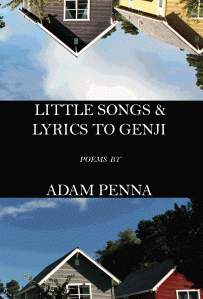
Little Songs & Lyrics to GenjiNext month, S4N Books releases my first full-length collection of poems, Little Songs & Lyrics to Genji.  Actually, the book contains not one full-length collection, but two long sequences.  The first, “Little Songs,” is a series of sonnet-like poems presented in the order in which they were written.  The second, “Lyrics to Genji,” addresses an imaginary friend named Genji.  These, too, are presented in the order in which they were written, and try to explore the same material “Little Songs” do, but from another, more playful perspective.  “Lyrics to Genji” is a response to a rejection letter I received after submitting some of the “Little Songs” to a magazine where I had always had luck publishing.  The editor of the magazine wrote me a handwritten note suggesting, for his tastes, my little songs were too sad.

When I began to write the little songs, the aim was merely to right myself each day.  These poems served as daily meditations, and so if they take a more spiritual or even devotional tone this is one of the reasons.  If you read the rest of the blog, you’ll see that, indeed, the poet’s attitude toward the spirit and the divine is a preoccupation of mine.  Further, I have suggested it ought to be a central concern for all poets and readers of poetry.  I can’t imagine an entirely secular poetry worth reading.  Every poet, and this ought to be especially true of American poets, I think, is a religious poet.  I mean religious, of course, in the widest possible sense of the word, and mean it to include those affiliated with a certain brand of religion and those who have found what suffices elsewhere.

It may be fair to say that this book, beginning with the little songs and ending with the lyrics, are the narrative of my spiritual attitudes as they developed over the course of more than a year.  My spirit has been and continues to be restless and curious.  And I find the more I search the more certain I am there is something to be found, and the more certain I am that almost all of my previous notions have been just as misguided as they have been earnest.  In fact, while it is safe to say that these poems accurately catalogue a desire for truth, they are also a chronicle of failures.  They  must be, because even the best poems must fail.  However close they come, that which a poem seeks to define always lies just beyond its power to say.  It is because of this that Whitman calls for strong readers.  Strong readers are ones that read keeping in mind that these are only outlines.

I have written a lot about what the uses of poetry are.  It many ways the poems in this book are the proving ground for those ideas.  Maybe it is more accurate to say that the entries here are extensions of notions, which were first discovered in these sequences.  I have followed the line of thinking, which I first read in Emerson, that says a man might put his faith in the fact that his work will cohere because there is something coherent in being.  This, then, isn’t only a literary or poetic faith, but a faith I have found to be true of my actions in the world.  These things we do mean something, and it is the job of faith to find what they mean with a full heart, a broken heart, or a heart on the mend.  Who could or would avoid such a charge would avoid all of life.  Or all of life worth living.

I have said that a poet, because he is a poet, may not be a better person but, because he writes poetry, is a better person than he would otherwise be.  I understand that this argument is an especially romantic one, but I mean it with all humility.  I didn’t write these poems, neither have I ever put pen to paper, because I thought that what I had to say was worth much to anyone else.  The writing of these poems, and all poems, is as selfish an art as one might endeavor to perfect.  And yet I can’t help but think that, at its best, poetry makes it possible, if nothing else, for the self, the weary, the silly and self-seeking atom, to escape those traps and blind alleys and find, in the end, the paradise it wanted to find.  I have not come to that walled-garden yet, but already I smell the fragrance of joy.  Perhaps it is just beyond.  Perhaps it is all around.

Posted in Starting from Poetry | Tagged , , , , , , , , , , , , , , , , , | Leave a comment

Sabbatical

I started this blog to correspond with my sabbatical, which began officially in January and ended when I taught my first class in September.  It was a rough few days the first week, and I’m still not altogether used to the daily responsibilities of an associate professor of English at a community college.  Sometimes I look back on the pace I was keeping even a year ago, a log marked by scores of emails and flyers and the like, and wonder, Who is that man?  My pace has slowed considerably.  My mind has slowed considerably.  I have slowed considerably.  And this is all for the good.  One can’t finish a marathon if one runs as if one is running a 50 meter sprint.  On the other hand, I wouldn’t mind, especially when I see my briefcase bulging with still-to-mark essays and stories, a little of that mania that characterized the first leg of my career.

I said I started this blog, but I ought to have said restarted, and I might have said revised it.  The idea of writing this time was to see what I could see about my attitudes toward poetry.  I have reread the posts now and again, and see that much of what I have said attempts to address the uses of poetry.  And I realize, too, that despite this struggle and the seeming conclusions I nearly come to, I don’t really know what I think.  I have hoped that poetry could change me.  I have staked my sanity and my career on the idea that living the life of a poet would, in the end, be a better life than one lived as anything else.  And the advantage of being a poet, of course, is that one can be anything else and a poet at the same time.  My first ideas about being a poet included not teaching Hamlet but pumping gas.  I might not have fared much worse than I have either.  And yet knowing what I know about my temperament, it is hard to imagine me doing anything else.  I believe I am unqualified to do anything but teach.

But perhaps all professors of English think this.  And who would blame them?  For one suited to the work, it can hardly be called work.  There are trials, but no more and certainly many less than other professions.  And poetry professors enjoy pleasures more rigorous scholars don’t.  Poets can, when they choose, wear the mask of the clown, for instance.  And I don’t mean they get to be funny.  Even a Marxist might be funny accidentally.  I mean the poet gets to be self-deprecating.  The poet-professor who fails to do this fails in more than one way.  First, he fails his students, and second, he fails himself.  I have come to believe that I am better at doing what it is I have been hired to do – and this is nothing short of changing the students who enter my classroom from the things they were to the things they might be – if I don’t confuse who I pretend to be with the person I am truly.  The same can be said of writing poetry, and to a lesser extent prose.

There is a part of me fulfilled by writing poetry, just as a part of me is fulfilled by being a husband or a son or a brother or a friend.  It is this part of me that doesn’t struggle with what it means to write poetry, to be a poet.  It is this part of me, who climbs the shingles of my roof at night and gazes out into the all of everything and, indeed, he understands.  It is the friend, the brother, the husband who is unsatisfied by all this climbing.  It is he who wants poetry to do more than it can do.  It is he, who thought a sabbatical would change him, would make him new, and therefore it is he and he and he, who is disappointed at what he has found.  A brother can only be satisfied by brotherhood, a husband by love.  But a poet is satisfied by poetry.

I had hoped that this sabbatical would explain to me what the seven years before couldn’t, and that is, Why do I write poetry?  I had begun to ask this question seriously when I started my full-time position.  I have, in the meantime, come to many conclusions, and some have even sounded the same as former conclusions and so passed for the truth.  But the truest thing I can say is this.  A part of me is satisfied by poetry.  And the rest, when the rest are silent, might listen to that and be satisfied, too.  Then, they might get back to the business of being a teacher, a husband, a brother, a son.  They might even get back to the business of loving this world as it is, without amendment; might even seek less and less to be understood and more and more to understand, as the good saint says.  He was a poet, too, after all, and a saint.  And when his love for God informed his urge to sing what he uttered was poetry.  If his urge to sing ever informed his love for God that has been forgotten and rightly so.

Posted in Starting from Poetry | Tagged , , , , , , , , , , | 1 Comment

Revision Means to See Again

I wonder sometimes why I began to write.  And sometimes I wonder why I still do.  I know my process well enough to know that I especially feel this way after a long bout of writing.  The last year has been a rather fruitful one, thanks in part to a sabbatical.  Just what kind of fruit the bout and the sabbatical have produced, I can’t tell yet.  It all seems to me now like so much rotten cabbage.  This says more about me than it does the work, of course.  (I remember Septembers in my old house.  The neighborhood was set on the edge of a cabbage field, and in those last hot days the heads stunk fiercely.  Now the fields are gone.)  One becomes fatigued by writing like this.  And that fatigue comes and goes frequently.  But there is a special fatigue, which comes infrequently.  I feel that now.  It suggests a need for reinvention.  A need to revise.

The less substantial fatigue calls me to revise, too.  Mostly, this call means revising a manuscript.  Fiddling with poems. Seeing what I had been trying to say muddled by what I had been hoping to say.  Or maybe that is backwards.  And what I was hoping to say was muddled by what I was trying to say.  (Maybe I had nothing to do with the enterprise at all!)  Maybe this fatigue I’m feeling now means only this.  I look over the manuscripts, and ask: What do I have here?  Can this be saved?  And if the answer is no, I set it aside.  Nothing can be done.  I’m not ready.  Or maybe, there is a poem, a group of poems, a little bit of prose, something–and if I see it, I might begin the difficult task of revising.  I cull through, looking for what ought to remain and discard the rest.  I polish.  I read.  I choose.

But if the fatigue is a special kind.  If I am really, truly sapped.  If I have said, in that way, all that I might, and I want nothing more to do with saying–then, the revision I mean might mean something more.  It may have to be more profound an activity.  It may have to be stillness and waiting.  It may mean that what I have to see again doesn’t lie on the page or between the covers of a book.  It may mean that the thing which desires to be seen again is deeper still.

I’m starting to mistrust the more profound declarations of change, which some–and I have been one–claim.  Somewhere in William James’ Varieties of Religious Experience, he talks about the phenomenon of conversion.  It’s not that I don’t think people can alter their behavior.  I know they can.  I see it all the time.  And I have done this, both for the good and the bad.  And these changes have overwhelmed me sometimes.  I have found myself struck, and the next morning the man I was and the man I am seem to be as distant as two feuding brothers.  Even my wife might touch my cheek and say, Who?  James suggests that these two feuding brothers, good and evil, prodigal and prudent, Cain and Able, are really two extremes of the same sphere.  And I believe that now.  How does a man know he has done wrong unless he knows what wrong’s opposite is?  How could he conclude, I have been mistaken?  And what is guilt or regret except one brother tapping the other on the shoulder?  Usually, it takes great pain, extremes of suffering, for an individual to make a shift like the one James describes.  And the revision of that man’s life, like the one Rilke appears to have at the end of his poem about the busted torso of Apollo, which seems to come suddenly–one day I am this, and this day I am that–has been ripening in him a long time.

My fear about changes like these is that they are superficial.  The decisions made by such a changed man are linked, albeit darkly, to that other half he disclaimed.  The danger, of course, is that in the end this new man, hoping to avoid the pain which caused the conversion in the first place, (though it might have been the best thing ever to happen to him,) ends up running headlong into the arms of that pain again or the circumstances that caused it.  Processes lead to ends, and I would suggest that it doesn’t matter the process, if the ends are the same.  This may be why the Greeks wisely point out that we should call no man happy until he is dead.  It is for these reasons, then, that what I’m looking to find isn’t a new process, which would always be in relation to the old one, but a new end, which transcends both old and new.  Or, perhaps better still, marries the two, so that the spheres I mention above embrace, and the feuding brothers are healed.  Their work can begin in concert, then.

I use to think that poetry could affect the kind of change I mean.  I doubt that now.  It might facilitate revision, in the best of circumstances, Dante’s for instance, but it is just as likely to lead one astray.  One might get lost a long time in that maze, and circle and circle, without respite.  This one would become either convinced that change is impossible or believe that it is as easy as moving one’s attention from here to there.  And so it may be that earnest longing brings us closest to our desired end, and so poetry may play a part but only a part.  Or it may be luck, or grace, or love that heals us.  Poetry contributes to some of this.  Or it may be in serving others, human kind or, more likely, the people we claim to love, our spouses and our children, that we find the profoundest change.  Poetry might help here.  Or it may be that revision like this is impossible.  Again, poetry might help.  And if we find we can’t change, that we are exactly this and nothing more, then let’s surrender only when it’s necessary.  Discarding a possibility before it has been thoroughly tested, before we have pried open our stubborn eyes or pressed our hot cheeks into the dust, seems to me to be about the most foolish thing we can do, short of concluding in our hearts what the fool concludes in the psalms.

Posted in Starting from Poetry | Tagged , , , , , , | Leave a comment